Master the Lattice of Mental Models for Sharper Thinking

Introduction to Mental Models
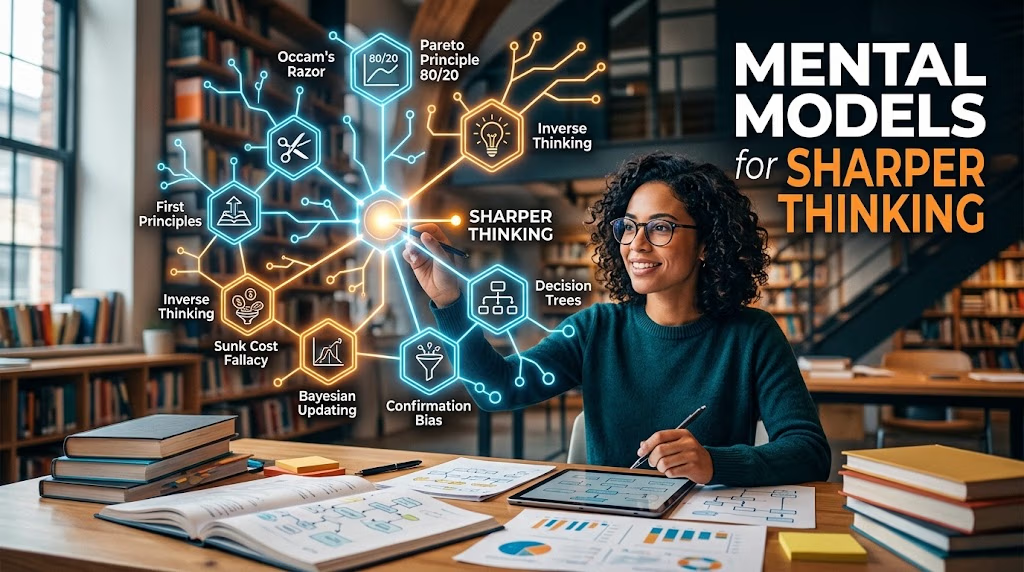
Mental Models for Better Thinking are core concepts shaping our understanding of the world. They serve as internal representations of external realities that facilitate reasoning, problem-solving, and decision-making. Essentially, mental models act as cognitive shortcuts, allowing us to process information more efficiently. By utilizing a variety of mental models from diverse fields, individuals can enhance their cognitive toolkit. Additionally, this improves their ability to navigate complex situations.
One of the key advantages of employing a latticework of mental models stems from the diverse perspectives they offer. For instance, integrating principles from physics can provide insights into cause-and-effect relationships. Concepts from biology might illuminate our understanding of systems thinking and interconnectivity.
Economics can offer frameworks for analyzing incentives and trade-offs, while historical models uncover patterns of human behavior over time. By drawing from this rich tapestry of knowledge, Mental Models for Better Thinking can guide better decision-making.
Cross-disciplinary thinking strengthens how we form models. Exploring ideas from domains such as science and social studies helps us view problems from multiple angles.
This combination leads to innovative solutions and a well-rounded understanding of challenges. Moreover, Mental Models for Better Thinking enriches our cognitive capabilities and optimizes thought processes.
As we proceed, we will delve deeper into how to effectively build a latticework of mental models, enabling us to enhance our cognitive abilities and approach decision-making with greater confidence and clarity. The journey through the interconnected web of knowledge reveals not just the complexity of thought, but also the profound impact that well-structured mental models have on our lives.
The Importance of a Latticework Approach
In the realm of cognitive development and problem-solving, the concept of a latticework of mental models lies at the heart of effective thinking strategies. By systematically intertwining vahttps://learnmosaic.online/wp-content/uploads/2024/12/vintage-electrical-and-electronic-appliances-in-an-2023-11-27-05-10-10-utc-e1734923695564.jpgus mental models from several disciplines, individuals can develop a more comprehensive understanding of complex issues. This approach not only enhances critical thinking skills but also encourages the application of diverse perspectives, which is vital in today’s multifaceted world.
Creating a latticework involves integrating different theories, frameworks, and insights that might originally seem unrelated. For instance, combining concepts from economics, psychology, and biology can yield unique solutions to business challenges. When individuals draw upon cross-disciplinary thinking, they are better equipped to identify patterns, make connections, and devise innovative strategies. This interconnectedness of ideas fosters a deeper level of reasoning and can lead to more nuanced decision-making.
Sourcing mental models from different fields serves multiple purposes. Firstly, it allows for a more holistic analysis of problems, as diverse viewpoints often reveal overlooked aspects of an issue. Secondly, this approach cultivates adaptability; when faced with new challenges, individuals with a rich repertoire of mental models can pivot their thinking and apply the most relevant concepts. Furthermore, utilizing a latticework of mental models helps sharpen intuition, as frequent exposure to vahttps://learnmosaic.online/wp-content/uploads/2024/12/vintage-electrical-and-electronic-appliances-in-an-2023-11-27-05-10-10-utc-e1734923695564.jpgus frameworks leads to the ability to recognize underlying principles swiftly.
Ultimately, the combination of mental models facilitates better decision-making frameworks. By leveraging insights drawn from a wide array of disciplines, individuals can cultivate a mindset that is flexible and responsive, enabling them to navigate complexity more effectively. This methodology not only promotes intellectual growth but also empowers individuals to tackle real-world challenges with more agility and insight.
Key Mental Models Across Vahttps://learnmosaic.online/wp-content/uploads/2024/12/vintage-electrical-and-electronic-appliances-in-an-2023-11-27-05-10-10-utc-e1734923695564.jpgus Disciplines
Mental models serve as the foundations of our understanding, enabling us to navigate complex problems more effectively. By leveraging a variety of mental models for thinking from different fields, we can construct a latticework of mental frameworks that enriches our cognitive abilities. This section will explore essential mental models across vahttps://learnmosaic.online/wp-content/uploads/2024/12/vintage-electrical-and-electronic-appliances-in-an-2023-11-27-05-10-10-utc-e1734923695564.jpgus disciplines that aid in better decision-making.
One prominent model comes from physics: systems thinking. This approach emphasizes the interconnectedness of components within a system, encouraging critical examination of how elements influence one another. For example, in environmental studies, recognizing how ecological systems function as a whole enables researchers and decision-makers to devise more sustainable practices and mitigate adverse effects.
In biology, the model of evolution showcases the principles of adaptation and natural selection. This framework can be applied to business strategies by advocating for adaptability in response to market changes. Companies that embrace continual evolution—updating their products based on customer feedback, for instance—are more likely to thrive in competitive landscapes.
The economic model of supply and demand vividly illustrates how market dynamics operate. Understanding this mental model is imperative for better decision-making in vahttps://learnmosaic.online/wp-content/uploads/2024/12/vintage-electrical-and-electronic-appliances-in-an-2023-11-27-05-10-10-utc-e1734923695564.jpgus business contexts, such as inventory management or price setting. By recognizing the balance between consumer demand and product availability, businesses can optimize their operations to align with market realities, ensuring profitability.
Lastly, considering historical context is another invaluable model from history. Awareness of past events and their outcomes helps us make sense of current world dynamics and informs future predictions. For instance, recognizing patterns from historical economic crises can guide policymakers to implement preventative measures in today’s financial systems.
Integrating these diverse mental models enriches our cross-disciplinary thinking and equips us with tools that foster innovative solutions. Through the application of these models, individuals can enhance their analytical capabilities and develop a robust framework for tackling decisions in any field.
How to Cultivate and Apply Your Latticework of Mental Models
Building a latticework of Mental Models for Better Thinking is a powerful technique that enhances our thinking and decision-making abilities.
Moreover, cultivate a diverse collection by engaging in a systematic approach to learning and applying them in daily life.
One of the first strategies is to actively identify and study vahttps://learnmosaic.online/wp-content/uploads/2024/12/vintage-electrical-and-electronic-appliances-in-an-2023-11-27-05-10-10-utc-e1734923695564.jpgus mental models applicable across diverse disciplines. This could include concepts like first principles thinking, which involves breaking down complexities into their fundamental parts, or cross disciplinary thinking, where insights from one field can influence understanding in another. Reading books, attending lectures, and engaging with podcasts can serve as valuable resources to expose oneself to a broad range of mental models.
It is essential to not only learn these models but to retain them through practical application. One effective method for this is to keep a journal where you catalog the models you encounter along with real-life examples of how they can be applied. This process reinforces memory and understanding, transforming theoretical knowledge into practical skills that improve decision-making frameworks.
Additionally, engaging in discussions with peers can significantly enhance your understanding of Mental Models for Better Thinking. Moreover, by explaining concepts to others, you reinforce your own comprehension and open yourself up to feedback and alternative perspectives. As a result, this collaboration can yield new insights and encourage integrating vahttps://learnmosaic.online/wp-content/uploads/2024/12/vintage-electrical-and-electronic-appliances-in-an-2023-11-27-05-10-10-utc-e1734923695564.jpgus models into your decision-making processes.
Additionally, to integrate Mental Models for Better Thinking into daily practice, develop a routine that prompts regular reflection. At week’s end, review decisions and evaluate which mental models influenced them.
Moreover, this reflective practice can highlight areas of improvement. It encourages more conscious application in future scenahttps://learnmosaic.online/wp-content/uploads/2024/12/vintage-electrical-and-electronic-appliances-in-an-2023-11-27-05-10-10-utc-e1734923695564.jpgs. Ultimately, consistent use of mental models leads to better decision-making outcomes. If you track results, you can refine your routine over time. This ongoing loop strengthens habits and makes thinking more automatic.
In conclusion, cultivating a latticework of mental models demands commitment and active engagement. By leveraging vahttps://learnmosaic.online/wp-content/uploads/2024/12/vintage-electrical-and-electronic-appliances-in-an-2023-11-27-05-10-10-utc-e1734923695564.jpgus learning strategies such as reading, journaling, peer discussions, and reflective practices, individuals can enhance their thinking skills, leading to more informed and effective decision-making.